Built first for hospital medicine, designed for any clinical group

Hospital scheduling is stuck in the 1990s. Meridyon is the rebuild.

Meridyon is the schedule's system of record: build the month on a real grid, let auto-fill do the heavy lifting, and publish once — trades, off-requests, and pickups flow through the same system. Underneath, a payroll-grade FTE/cFTE engine keeps the workload honest. Built by a practicing hospitalist who got tired of the desktop-era tools.

No credit card required. Self-serve setup in minutes — your own org, your roster, your schedule.

Why Meridyon

Three problems, one platform

For schedulers and department admins

Build, publish, and run the schedule — without the spreadsheet

You know the routine: draft in Excel, re-key it into the legacy tool, then field the email avalanche when something changes. Meridyon ends the re-keying. Build the month on the grid, or let the automated builder fill it — respecting eligibility, rest, and each provider's targets — then publish once. Trades, off-requests, and pickups flow through the same system, so the published schedule is never three edits behind the truth.

  • By-Shift and By-Staff calendar views; drag to move and swap in the By-Shift view
  • Auto-fill a month — or a whole year — then fine-tune by hand
  • Natural-language rules: type "Dr. Smith doesn't work Fridays" and it becomes a constraint
  • Providers email their requests in; AI parses them into one-click approvals in the app

For practice-plan and C-suite leadership

See how contracted cFTE translates into actual clinical work

At the practice-plan level, leadership funds cFTE on paper and then can't see what it buys. Meridyon holds both sides of the ledger: the contracted FTE/cFTE targets and the actual scheduled assignments, inpatient and outpatient. Paper cFTE becomes auditable against real scheduled work — by provider, by cohort, by department.

  • Per-provider FTE/cFTE targets, with separate inpatient and outpatient budgets
  • Cohort scopes: physicians, APPs, per-diem, trainees
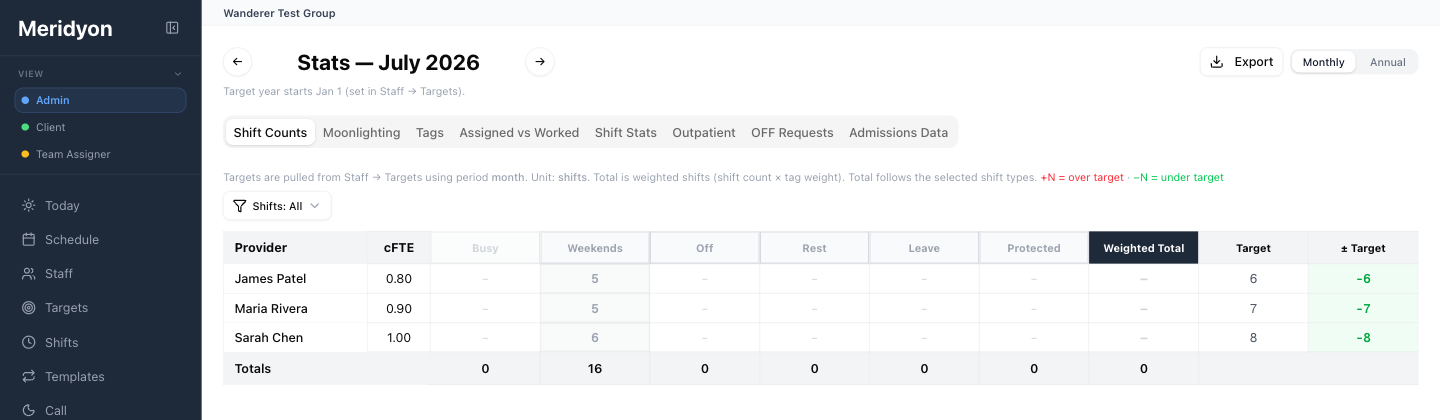
  • Workload distribution by provider and shift type, target-vs-actual tracking, and weekend counts
  • Measures scheduled clinical work — not billing or RVUs

For health systems

Match your own workforce to your own open work — before buying locums

When every department schedules in a different tool, nobody can see that Site B is paying locum rates while a credentialed clinician at Site A had open capacity. Put departments on one platform and open shifts become visible system-wide: post them to the board, attach a rate if you're paying one, and let your own people claim the work.

  • Multi-organization structure: health system → department → subdivision
  • Open-shift / moonlighting board with optional shift rates
  • Cross-department credentialing with per-department FTE
  • Surfacing and pickup ship today; you decide who works where

See it

This July built itself

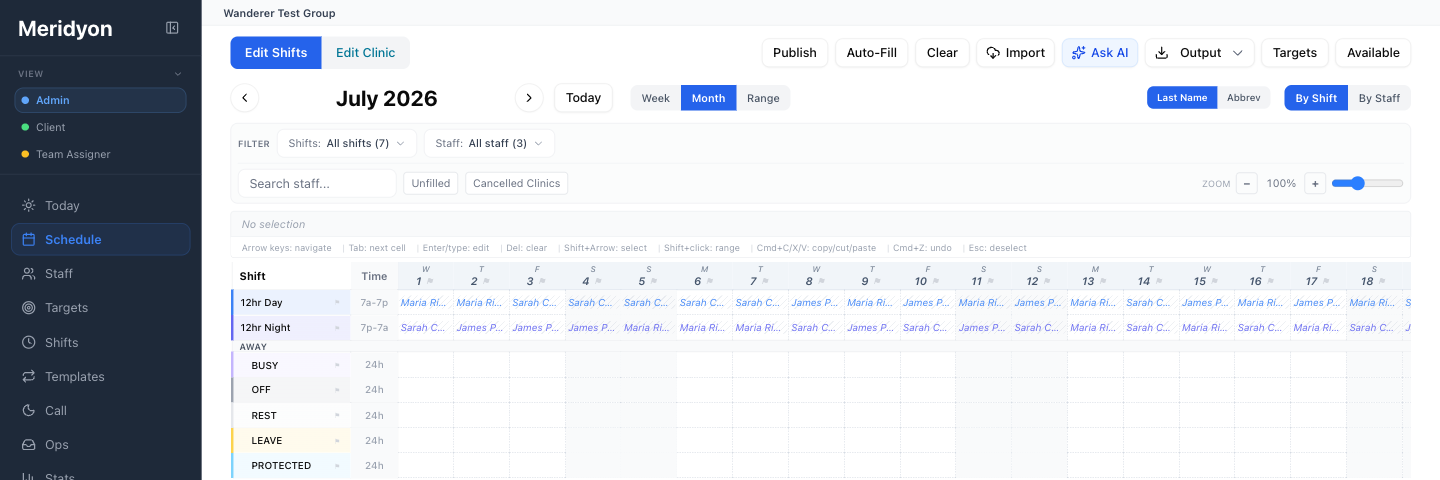
Real product, fictional names. One auto-fill pass covered every day and night shift in the month — eligibility, rest, and targets respected — and left it ready to publish.

Meridyon schedule in the By-Shift grid view showing July 2026 fully assigned: 12-hour day and night shifts covered on every date, with Publish, Auto-Fill, and Import controls in the toolbar.
The By-Shift grid after one auto-fill pass: every 12-hour day and night shift in July covered.
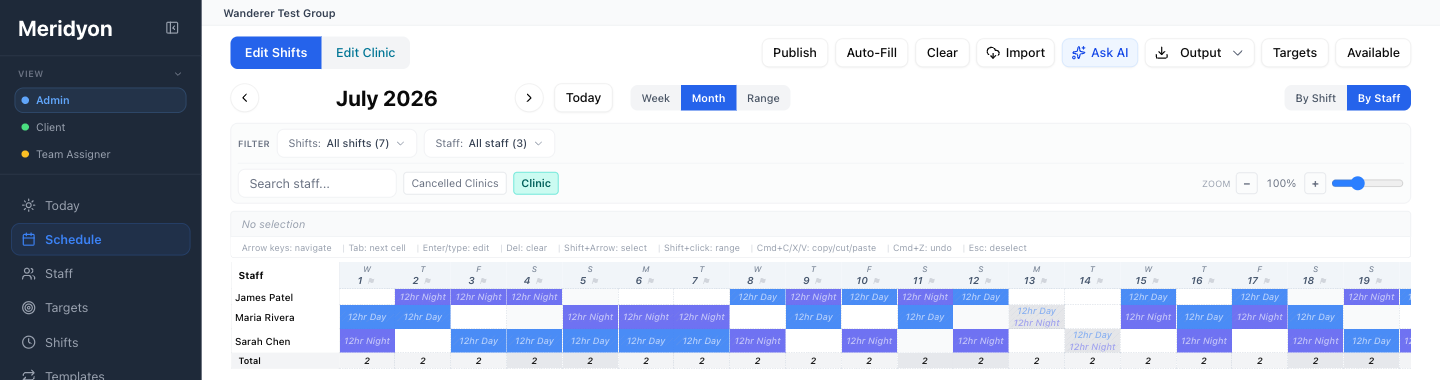
Meridyon schedule in the By-Staff view showing each provider's July 2026 assignments as a row of day and night shifts, with per-day totals along the bottom.
The same month By-Staff: each provider's pattern at a glance, with daily totals.
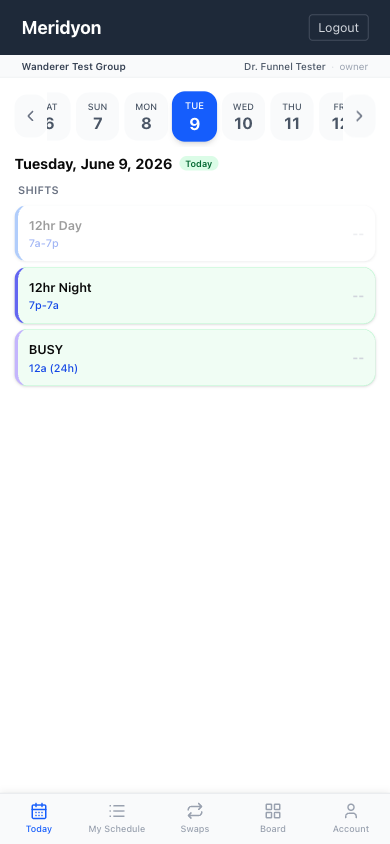
Meridyon mobile Today view on a phone, listing a provider's shifts for Tuesday, June 9, 2026, with a week strip across the top and Today, My Schedule, Swaps, and Board tabs below.
The Today view on a phone. Providers see their own day in one tap — and after 8pm, mobile switches itself to dark mode.

Features

Everything here ships today

Automated schedule builder

Fill a month — or a whole year — of shifts automatically, respecting eligibility, rest, and per-provider targets. Then fine-tune by hand.

FTE/cFTE workforce targets

Payroll-grade per-provider target math: Simple FTE or FTE-Components mode, separate inpatient and outpatient cFTE budgets, configurable weekly-hour caps.

A grid that works like a grid

Monthly calendar with By-Shift and By-Staff views, keyboard navigation, copy and paste. Move and swap assignments by dragging in the By-Shift view.

AMiON import & sync

Bring your current schedule across with assisted provider matching — name, phone, and ID, every match admin-confirmed — then keep an ongoing sync running during your transition. No roster re-keying.

Natural-language rules

Type "Dr. Smith doesn't work Fridays." Meridyon parses it into a structured constraint the schedule builder respects. No rule-syntax manual.

Shift trading

Provider-initiated swaps and giveaways with approvals and email notifications. Admin sign-off is enforced for sensitive trades.

Open-shift & moonlighting board

Post uncovered shifts — with a rate, if you're paying one — and let eligible providers pick them up.

Enterprise SSO & passkeys

OIDC SSO (Okta, Azure AD, Google Workspace) with verified ID tokens, plus passkeys/WebAuthn.

Calendar feeds & exports

Personal iCal feeds for Google, Apple, and Outlook calendars, plus CSV exports for admins. Your data stays yours.

Email request parsing

Providers email their off-requests and trades to the schedule's address. Meridyon parses them with AI and queues them for one-click approval in the app.

Workload & equity analytics

Workload distribution by provider and shift type, target-vs-actual tracking, and weekend counts across the group. The "who always gets the bad weeks" argument, settled with data.

Mobile-first, auto dark mode

Web-native and built for phones. After 8pm, mobile switches itself to dark mode — night-shift eyes were a design requirement, not an afterthought.

The story

Built by a hospitalist

"Hospital scheduling is stuck in the 1990s."

Meridyon exists because its builder kept finishing the schedule at 11pm with a spreadsheet on one screen and a desktop-era tool on the other. It's a ground-up rebuild — web-native, mobile-first, AI-assisted where that actually helps — by a practicing hospitalist who still publishes the schedule he works. That's why it understands call cycles, team assignment boards, and downtime admit sheets: workflows generic shift apps don't know exist. Because scheduling shouldn't require a Windows XP machine.

Built by a hospitalist, for hospitalists — and designed to schedule any clinical group, inpatient or outpatient. Hospital medicine is the beachhead, not the ceiling.

Pricing

One price. No tiers. No sales calls.

$12 per active provider / month

  • 30-day free trial — no credit card required
  • Billed per active provider, with proration
  • All features included — no tiers
  • Never locked out of your own data — read access stays on even if a payment fails
  • Cancel anytime
Start your free 30-day trial

FAQ

Straight answers

Does Meridyon store patient data?

No. Meridyon stores no patient records or clinical data — it schedules clinicians, not patients. That means a lighter security review for your IT team, and no BAA is required.

How does pricing work?

One price: $12 per active provider per month. Every account starts with a 30-day free trial — no credit card required. Billing is per active provider with proration, and you can cancel anytime. There are no tiers and no enterprise sales process. If a payment ever fails, you get a 7-day grace period and read access is never cut off — you are never locked out of your own data.

Can I import my current schedule?

Yes. Meridyon imports schedules from AMiON with assisted provider matching — providers are matched by name, phone, and ID, and an admin confirms every match before anything is written. You can also run an ongoing sync during your transition, so Meridyon stays current while both systems are live. No roster re-keying.

Do you support SSO?

Yes. Meridyon supports enterprise SSO via OIDC (Okta, Azure AD, Google Workspace) with full ID-token verification, plus passkeys (WebAuthn) and standard session sign-in.

How are providers notified of schedule changes?

Notifications are email-only today: schedule-change emails and trade notifications. Providers can also email their off-requests and trades in — Meridyon parses them with AI and queues them for one-click approval in the app. SMS and push notifications are on the roadmap, not shipped yet.

Can I get my data out?

Yes. Every provider gets a personal iCal feed that subscribes in Google Calendar, Apple Calendar, or Outlook; admins can export schedules as CSV and audit logs as CSV or JSON. Your data stays yours.

Your next schedule could build itself

Sign up, bring your roster, set your targets, and publish. Self-serve from the first click — no demo gatekeeping, no sales call.

Start your free 30-day trial